
81·
8 months agoWe’ve got to do something about these mods, folks.

Father; husband; mechanical engineer. Posting from my self-hosted Lemmy instance here in beautiful New Jersey. I also post from my Pixelfed instance.
We’ve got to do something about these mods, folks.

What are “end-of-life batteries” in this case? Is the plan to reuse used batteries that are no longer fit for automotive service?
I didn’t even consider that, but yes if votes can’t be private then it’s bad to pretend that they are. It looks like there’s been some debate on the topic, but the decision was apparently to keep pretending.
Maybe I misunderstood, but I thought the issue was with the follower approval feature. Apparently on Mastodon, users have the option to review all prospective followers. With this setting enabled, no one is supposed to be able to just follow your account with a click. You have to approve each one. Pixelfed wasn’t honoring this setting. I think it’s a bad feature that gives anyone who uses it a false sense of security.
Those are fair considerations. However, I think in the context of a massive cargo ship, a penalty on energy density might be worth it to avoid the risks associated with ammonia releases. Of course, a nuclear reactor powered ship would run on the highest energy density fuel and is arguably safer to operate than a ship that runs on ammonia.
Hydrogen is definetly harder to store than ammonia and it takes a lot of energy to compress or liquify it.
It takes a lot of energy to convert hydrogen to ammonia and whatever challenges there are to handling and storing hydrogen, ammonia has its own. At least a hydrogen release isn’t a toxic, polluting event.
And I certainly don’t want commercial nuclear ships, because companies will just create “independent” companies that will “mysteriously” go bankrupt once a ship reaches end of life and needs to be decontaminated.
So the taxpayer would have to pay for the decomissioning costs.
Yes. Let’s just get ahead of the game and nationalize shipping.
Hydrogen will leak through a latex balloon, but it is not going to leak through the steel wall of a pressure vessel. The leak risk occurs at the various fitting connections in a hydrogen system, which is overcome by using the proper fittings.
That is an interesting article, but the authors are clear that they don’t know what to expect for hydrogen leakage in a developed hydrogen economy. Sure, hydrogen might be a greenhouse gas, but you can’t really compare it to carbon dioxide because that’s a waste product that we actively dispose of to the atmosphere. You can’t really compare it to methane either because it’s naturally abundant and the LEL is much higher. Relatively leaky valves and fittings are unfortunately acceptable in natural gas service. In other words, hydrogen leakage is barely tolerable, so we have no choice but to employ technology and techniques to prevent it.
It does not leak like crazy. I know because I have experience engineering and operating high pressure electrolysis, storage, and fueling systems for hydrogen. Even when it does leak, what’s nice about hydrogen is that it’s not toxic to humans or pollutive to the environment, unlike ammonia or fossil fuels. Hydrogen leaks are easily mitigated with proven detection and ventilation techniques.
The serious issues in the articles you linked are essentially red tape and public perception, which have to be surmountable if we’re taking global warming seriously.

UPDATE: the battery fire obviously didn’t help, but according to new reporting it turns out that the Cybertruck really did trap the victims inside.

Why run ammonia when you can just run liquid hydrogen? Why run liquid hydrogen when you can just run a nuclear reactor?

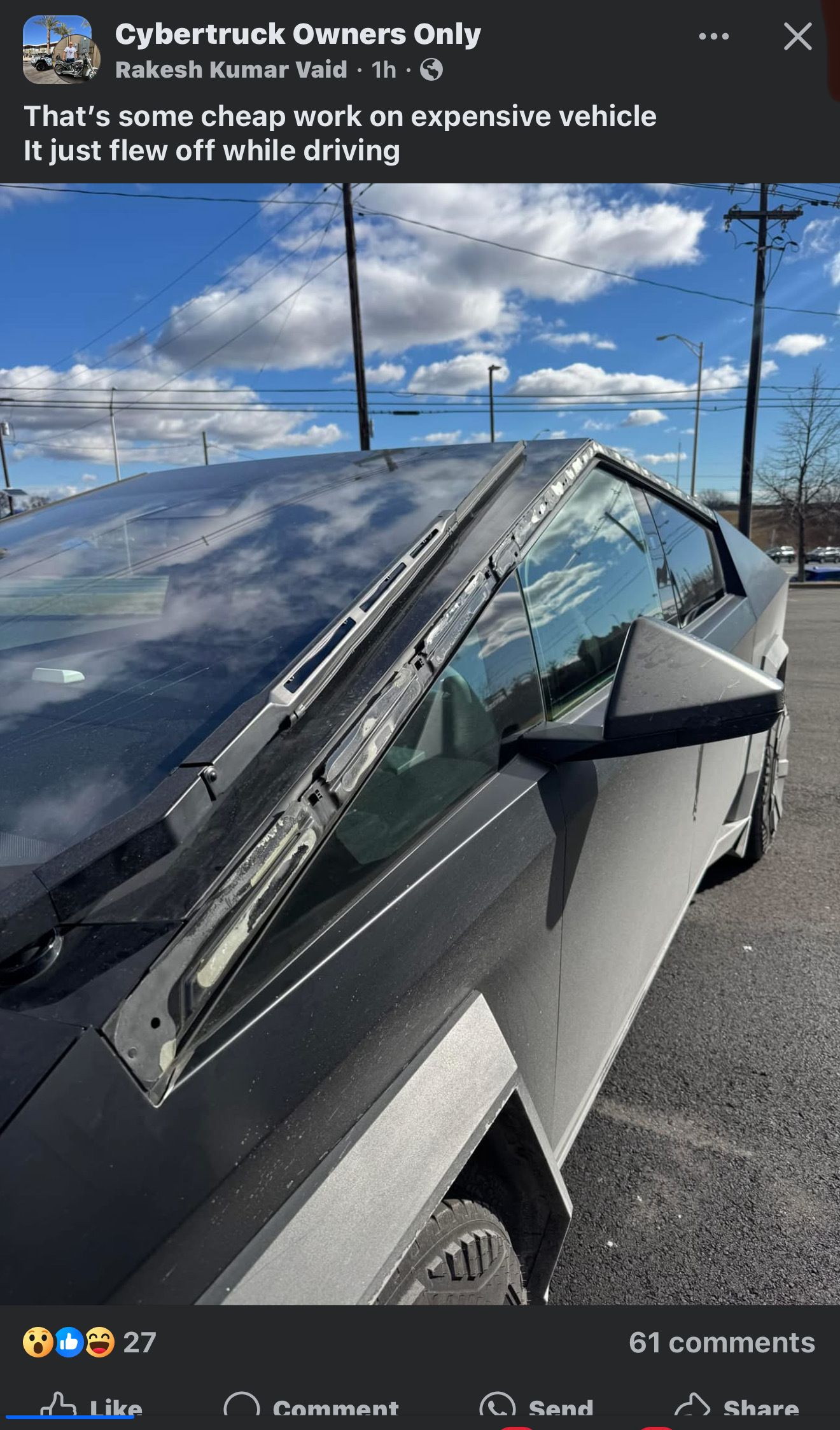
Yes. Windshields are important, heavy components which are fastened the the exteriors of automobiles with glue.
But, the next thing for me is acknowledging the terrible physics quandary of storing huge amounts of energy in a readily accessible form, without any chance of it releasing in an unintended manner.
Electric car makers are under a lot of pressure to provide more and more range, which has lead to them cramming such strong batteries in.
Even a garage door spring can murder you horribly if it fails. However, it’s a manageable risk that works well for the application. I think lithium batteries are a significant risk and badly suited to the application of long range personal vehicles. Personal BEVs should just have small batteries intended for overnight charging from residential power connections.
Windshields are the big one. This industry article provides a summary of adhesive use in auto manufacturing.
No idea.

What you’re describing only works if an increasing number of parking spots have chargers installed at them. I just don’t think it’s sustainable or feasible.
My main contention is that long range BEVs are a bad idea. They might mitigate greenhouse gas emissions, but that comes with the above infrastructure problems, increasing demand on the problematic battery industry, and in turn creating more battery disposal problems. Furthermore, they perpetuate the living room on wheels paradigm that holds us back from the real solution to transporting people over land: rail. Meanwhile, short range BEVs are great because they make the most of their batteries, barely require any new infrastructure, and save their owners the hassle of needing to visit a gas station or find a “fast” charger at all.














Food grade lubricant?