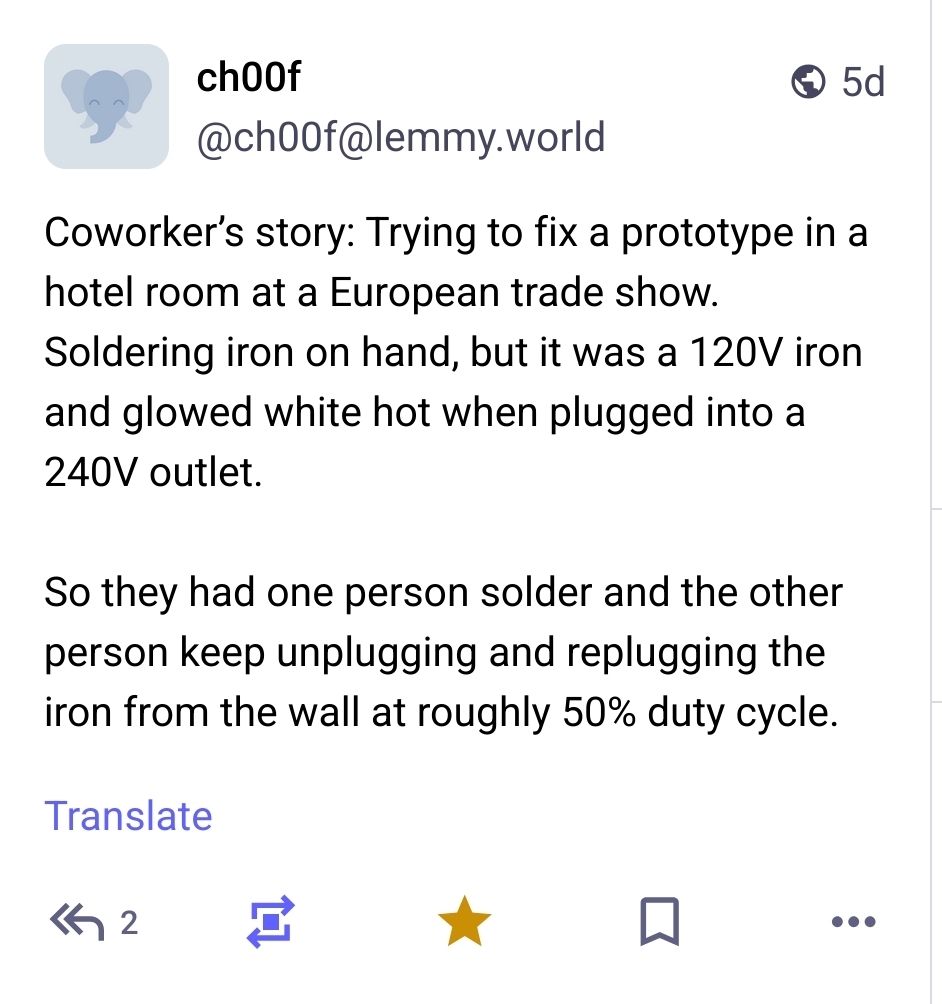
Shoudn’t it be 25%?
Current is not controlled here, resistance (aka the soldering iron) and voltage are.
Power = Voltage ^ 2 / Resistance. Double the voltage, that quadruples the power. So you only want to plug in 25% of the time to get the equivalent power of 120V.
But it might not melt at double power? Maybe the extra heat helps, I can’t find a resistance/temperature curve for a soldering iron…
Source: EE dropout.
nnnNNEEEEEEERRRRRRRRRd!
Ok. I was acountless on lemmy for a long time, your comment made me finally register. Thanks!
So, yeah, with double the voltage you get 4x the power. But you you put 4 times the power at 50% of the time, you get only 2x the power. And the other half of the time, you get 0 power. On the average you get the same power output.
You double counted there.
You said 4x power 50% of the time and then said “the other half of the time.”
So you’re calculating 50% of 50% which is 25% duty cycle.
Oh no, I didn’t. Should I draw a graph? Pop out some equations?
Let’s say P is the nominal power. When I said “The other half” I meant when the solder iron is not plugged. So:
50% of the time at 4xP 50% of the time at 0…
Oh shizzzz, you’re right!
I imagine this is more or less what it felt like to be in the room at the time. A whole group of people discussing electrical theory and optimal soldering techniques and meanwhile the one guy standing there holding the actual device notices the power cord is a little loose and pushed it in another 1/8" without mentioning it because everyone is so involved in their nerdy conversation.
Finally, an usecase for USB irons!
I just got one, and it’s so practical with a PD battery bank. Can now solder inside or outside on my car/bike with zero hazzle
I have one too, I like the idea of it but can’t solder with it. For any serious work I use my old transformer iron that has enough power to melt the solder.
Sure, a Weller station will probably last a lifetime even with serious usage, but I do maybe…. 20 total solder joint per year, so I couldn’t justify the price.
I do agree that it’s better at what it’s supposed to do though
Not quite a Weller station, but also will last a lifetime ;)

Edit: I’m aware that USB irons are good and I’m just shit at using them
I really appreciate that you took the time to take a photo to show us your iron. It’s nice to get the more personal touch as I keep forgetting we are real people talking together.
It looks like an old clenodium. I’m sure it has seen its fair share of work. Thanks for sharing!
Removed by mod
Link?
Removed by mod
deleted by creator
I’ve had a similar experience as a child. I live in Germany and found this voltage switch on a hair dryer. My thoughts were like: Switching it to less couldn’t possibly hurt, could it? Well it could. It was super efficient though but only for a few seconds before it self destructed.
It’s only stupid if it doesn’t work
Because the plug would fit the outlet, right?
There are a bunch of adapters you can buy that don’t convert voltage, and it’s pretty common for people to buy them by mistake.
and it’s pretty common for people to buy them by mistake
Or even on purpose, for the many things that don’t care (a lot of electronics, where it has a rectifier, are fine with 110-250V, 50-60Hz)
I hope this is a bs story for clout, you can buy universal power converters at airports.
Don’t those just make the plugs fit? Isn’t that the point of the story?
deleted by creator
New manufacturing hack unlocked: Install 240v outlets at workstations and fire half of the workforce. Golden parachute and douchey, hand-wavey TED Talk, please!
Elon knows more about manufacturing than any other person on earth, he said
Why plug and unplug? Doesn’t the wall outlet have a switch?
I have actually never met a wall outlet with a switch.
Really? Where are you for that? I don’t have a wall outlet without a switch, and I’ve never seen one because why would it just be live all the time?
I’m in Australia for reference.
We’re the exception, most places don’t have switches on their outlets.
Afaik it is a safety thing that is handled differently in different countries.
Uk and their colonised countries have this. The reason is that the fuses are in each plug. But no (or almost no) fuses in the power grid of the house. In Europe most countries have a single GFCI and several fuses for power grid sectors in a single place in the house where the power comes in.
I assume the switches on the power outlets are for turning off a switch because there is no GFCI in the house.
I think in the UK at least this view might be a little outdated - every house I’ve ever lived in has had GFCI sectors across the house, or had to be updated to have it when work was done.
Well I would need to do research on that so I can make actual claims here, but I think the switches on the power outlets are somewhat related to the kind of how fuses are handled.
I think it’s mostly due to the the way the “ring mains” are often wired in UK to basically cheapout of copper I think . . .
The consumer unit/fusebox/gfci protects the whole ring mains wire from overheating or ground leakage - up to the socket - but that will likely be more current than any individual appliance would want to see maybe 20A or 32A or something. So it’s up to the appliance to protect itself (and its wiring from the plug) from overcurrent scearios per its own tolerances.